
Performance · Energy
Energy efficiency of Schueco uPVC windows
The figures your energy assessor needs: frame Uf from Schueco's tables, whole-window Uw and SHGC from our WERS ratings, and air infiltration for each product. Use them to model BASIX or NatHERS with real windows instead of defaults.
Uf, Ug and Uw
Three U-values describe a window, all in W/(m²K). Lower means less heat passes through.
- Uf (frame). The frame and sash profile on its own. CT 70 reaches Uf from 1.2, with most frame and sash combinations between 1.2 and 1.6 depending on glass thickness and steel reinforcement. SoftSlide starts at 1.4 and EasySlide at 1.47 in Schueco's headline figures.
- Ug (glass). The centre of the glass unit. This is where double and triple glazing, low-E coatings and gas fill make the difference.
- Uw (window). Frame, glass and the glass edge combined, for a given size. This is the number that goes into an energy assessment, together with SHGC.
A low-Uf frame matters most on small windows and on windows with many sashes, where the frame is a large share of the area. On a big fixed light, the glass dominates.
Reading the isotherm
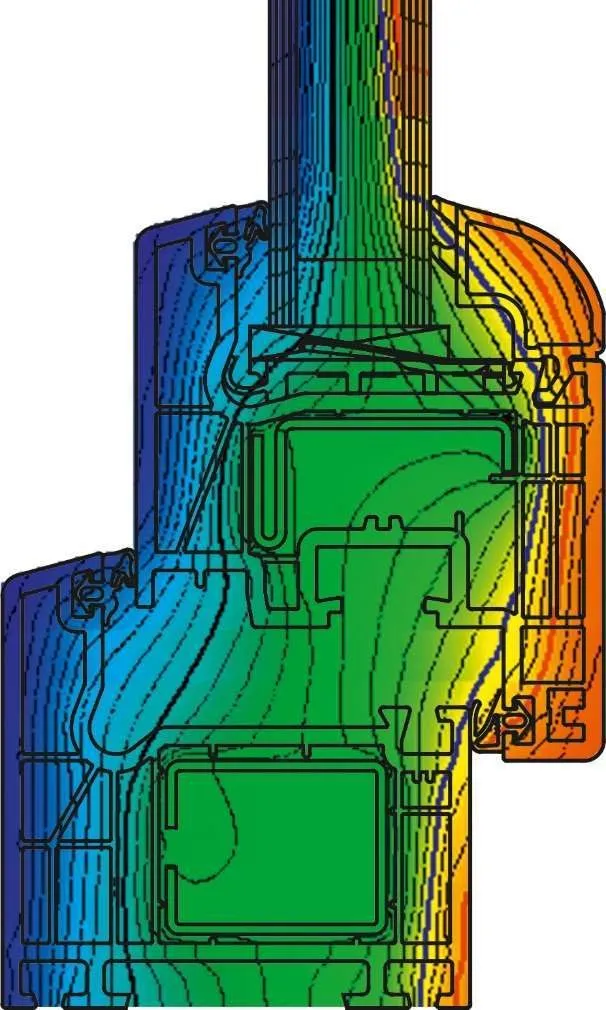
The isotherm shows how temperature falls across a CT 70 section on a cold day. Five chambers in the frame and two continuous gasket levels hold the cold near the outside face, so the inner surface of the frame stays warm. A warmer inner surface means less condensation on the frame, which matters in Blue Mountains, Southern Highlands and other cold-winter jobs.
Air infiltration
Leaky windows undo good glass. WERS lists air infiltration in L/s·m², and the spread across our range is wide. CT 70 tilt and turn and fixed windows rate 0.03, hinged doors 0.04, casement and awning windows 0.22. Hinged sashes clamp shut against gaskets with multi-point locking. Sliding sashes have to move, so SoftSlide doors and windows rate 0.64. If airtightness is a priority on a job, put tilt and turn or fixed units where you can and keep sliders for the openings that need them.
| CT 70 frame + sash | 1.2–1.6 W/(m²K)24 mm glass; 1.2–1.5 with 36 mm glass. Schueco CT 70 Uf tables |
|---|---|
| CT 70 Classic, standard combination | 1.3 / 1.2 unreinforced; 1.4 / 1.4 with steel in frame and sash24 mm / 36 mm glass |
| CT 70 fixed glazing (frame only) | 1.1–1.6 W/(m²K) |
| CT 70 outward-opening sash | 1.3–1.5 W/(m²K) |
| CT 70 door with threshold | 1.4–1.9 W/(m²K) |
| SoftSlide | From 1.4 W/(m²K)Schueco headline figure; varies by profile combination |
| EasySlide | From 1.47 W/(m²K)Schueco headline figure |
| Window example (Uw) | 1.3 W/(m²K), CT 70 double glazedSchueco brochure P4119 |
Uf tables are in our downloads. Your assessor uses the WERS Uw and SHGC below, not Uf.
WERS ratings
Uw, SHGC and air infiltration by product
Our windows and doors are rated in the Window Energy Rating Scheme under the manufacturer name Sustainable Windows, with Australian Glass Group (AGG) glass units. 340 ratings in total.
| Product (WERS name) | Ratings | Uw W/(m²K) | SHGC | Air infiltration L/s·m² | Glazing | Lowest Uw, glass unit |
|---|---|---|---|---|---|---|
| CT 70 Tilt and Turn Window | 57 | 1.2–2.1 | 0.12–0.39 | 0.03 | Double, triple | 1.2, AGG PLUS + PLUS Clr 6/12/6/12/6 - WE |
| CT 70 Fixed Window | 57 | 0.9–2.4 | 0.18–0.62 | 0.03 | Double, triple | 0.9, AGG PLUS + PLUS Clr 6/12/6/12/6 - WE |
| CT 70 Casement Window | 43 | 1.6–2.2 | 0.12–0.39 | 0.22 | Double, triple | 1.6, AGG PLUS Clr 8/12/8 - WE |
| CT 70 Awning Window | 43 | 1.6–2.2 | 0.12–0.39 | 0.22 | Double, triple | 1.6, AGG PLUS Clr 8/12/8 - WE |
| CT 70 Hinged Door | 57 | 1.1–2.2 | 0.14–0.48 | 0.04 | Double, triple | 1.1, AGG PLUS + PLUS Clr 6/12/6/12/6 - WE |
| SoftSlide Sliding Door | 41 | 1.6–2.5 | 0.17–0.56 | 0.64 | Double | 1.6, AGG ADVANCE Clr 8/12/8 - WE |
| SoftSlide Sliding Window | 42 | 1.8–2.5 | 0.14–0.47 | 0.64 | Double | 1.8, AGG PLUS Clr 8/12/8 - WE |
Source: WERS (werslink.com.au), manufacturer "Sustainable Windows", checked 1 October 2026. Glass descriptions are as listed in WERS. EasySlide lift and slide doors have no WERS ratings yet.
BASIX and NatHERS
How the window data gets into an assessment
Windows aren't approved for BASIX on their own. In NSW, BASIX sets energy, water and thermal comfort targets for the whole home, and the thermal comfort part is usually shown with a NatHERS assessment. Outside NSW, the NCC energy provisions apply, again usually through NatHERS. Either way, the assessor models the house room by room, and each window goes in as a size, an orientation, a Uw and an SHGC.
If the assessor uses generic default windows, the model is often harder to pass than it needs to be. With WERS rating IDs for the actual products, the assessor enters real values, and you can see which openings are worth upgrading.
Send the schedule
Opening types and sizes, plus any glass the assessor has already assumed.
We match WERS ratings
For each window type we give the rating ID, Uw, SHGC and air infiltration of the glass unit we'd supply.
The assessor models the home
If a target is missed, change glass on the openings that matter (often large west and north glazing) rather than the whole house.
Quote matches the certificate
We price the glass units that are on the BASIX certificate, so what's delivered matches what was assessed.
SHGC
Heat gain matters as much as heat loss
SHGC (solar heat gain coefficient) is the share of the sun's heat that gets through the window. Our WERS ratings run from SHGC 0.12 to 0.62. A low SHGC limits summer heat on exposed west and north elevations. A higher SHGC lets winter sun warm a living area that's well shaded in summer. The assessor can pick the right balance per orientation, and we supply what they pick.
Double or triple
Double vs triple glazing
CT 70 takes glass units up to 42 mm, so both work in the same frame. The WERS figures show what triple glazing buys: the lowest-Uw ratings for tilt and turn (1.2), fixed (0.9) and hinged doors (1.1) all use a triple glazed AGG PLUS + PLUS unit.
- Double glazing covers most Sydney and coastal NSW jobs. Low-E coatings and gas fill do much of the work.
- Triple glazing is worth modelling for cold climates, high star targets, large glazed areas and acoustic jobs, where the extra pane also helps.
- Weight goes up with triple glazing. Schueco's size tables set sash limits by glass weight, so check large sashes with us first.
- SoftSlide is rated with double glazing only. For triple glazed large doors, ask us about EasySlide.
Tilt and turn windows
Lowest air infiltration in our WERS range (0.03 L/s·m²) and Uw down to 1.2 triple glazed.
Tilt and turn →Fixed windows
Our lowest WERS Uw, 0.9 W/(m²K) triple glazed. Use them where you don't need an opening.
Fixed windows →Acoustic glazing
The same frame takes acoustic laminated glass. See how sound and energy targets fit together.
Acoustic →Need WERS rating IDs for your assessor? Send the window schedule.
FAQ
Questions from builders and architects
What is the difference between Uf and Uw?
Uf is the heat loss through the frame and sash profile alone, measured in W/(m²K). Uw is the whole window: frame, glass unit and the glass edge together, for a set size. Energy assessors use Uw and SHGC. Uf matters when you compare profile systems or calculate a custom size.
Do you supply WERS data to energy assessors?
Yes. Our products are rated in WERS under the manufacturer name Sustainable Windows with AGG glass, 340 ratings in total. Tell us the opening types and glass units and we'll send the rating IDs so the assessor can enter the actual Uw and SHGC instead of default values.
Do I need triple glazing to pass BASIX?
Not usually. BASIX looks at the whole home, so glazing is one input alongside orientation, shading, insulation and the building fabric. Double glazed CT 70 windows give WERS Uw values from 1.6 W/(m²K) on casement and awning windows, with lower figures on tilt and turn, fixed and hinged doors. Triple glazing is worth modelling for cold climates, large glazed areas or a high star target.
Why is the air infiltration figure for sliding doors higher?
Hinged sashes close against compression gaskets and are pulled tight by multi-point locks, so tilt and turn and fixed CT 70 units rate 0.03 L/s·m² in WERS. A sliding sash has to move along its track, so its seals can't clamp in the same way. Our SoftSlide sliding doors and windows rate 0.64 L/s·m².
Is there WERS data for EasySlide lift and slide doors?
Not yet. For EasySlide we can provide Schueco's Uf tables (Uf from 1.47 W/(m²K) as Schueco's headline figure) so your assessor can work with them. Ask us before you lock in an energy model that relies on a large lift and slide door.