
Performance · Acoustic
Soundproof windows and doors in Schueco uPVC
For builders and architects working to an acoustic report. Schueco CT 70 windows are tested to Rw 47 dB, EasySlide lift and slide doors reach 43 dB and CT 70 entrance doors 38 dB. On sites near motorways, rail lines and flight paths, we match the glass unit in each opening to the rating the report sets.

What "soundproof" means on a specification
No window stops all sound. On drawings and in acoustic reports, a soundproof window is one whose tested sound reduction (Rw, sometimes Rw + Ctr) is high enough to bring the room down to its internal noise limit. It is a number to meet, opening by opening.
Where the sound gets through
A closed window lets noise in three ways: through the glass, through the frame, and through gaps around the sash. CT 70 deals with the last two. The 70 mm, five-chamber frame is stiff and steel-reinforced, and two continuous gasket levels, pulled tight by multi-point locking, close the gaps that let sound leak around a sash.
That leaves the glass unit as the variable. The same CT 70 window, tested by Schueco with different glass units, moved from Rw 38 dB to Rw 47 dB. Nothing else changed.
What changes the glass result
- Laminated glass with an acoustic interlayer. The top tested units use laminated panes on both sides of the cavity.
- Different pane thicknesses. Two panes of the same thickness resonate at the same frequency. Mixing thicknesses breaks that up.
- Overall thickness. Heavier, thicker units block more sound. CT 70 accepts glass units up to 42 mm, which leaves room for thick acoustic laminates.
- Hinged rather than sliding. Hinged sashes compress their seals. That's why our highest figures are on tilt and turn windows and hinged doors.
| Glass unit Rw | Window Rw |
|---|---|
| 36 dB | 38 dB |
| 42 dB | 41 dB |
| 44 dB | 43 dB |
| 45 dB | 45 dB |
| 46 dB | 45 dB |
| 49 dB | 47 dBC = −1, Ctr = −3. Report 21-001425-PR01, 29.06.2021 |
| 50 dB | 47 dB |
Source: Schueco sound insulation overview for CT 70 (test reports 18-003052-PR02 and 21-001425-PR01). Laboratory values for the stated size. Results on site depend on installation, the wall and the window size. Full test overview available to acoustic consultants on request.
| CT 70 windows | Up to Rw 47 dBTested, tilt and turn |
|---|---|
| CT 70 doors, incl. entrance doors | Up to Rw 38 dBSchueco FF2026 brochure |
| EasySlide lift and slide | Up to Rw 43 dBSchueco FF2026 brochure |
| SoftSlide sliding | Not rated by Schueco |
For builders and architects
Specifying soundproof windows for road, rail and aircraft noise
Most acoustic work we quote comes from one of three sources. Each has its own rule, but the job always runs the same way: the acoustic consultant sets a rating per facade or room, and the window schedule has to carry it through to the order.
Busy roads
Under section 2.120 of the NSW State Environmental Planning Policy (Transport and Infrastructure) 2021, homes next to a freeway, tollway, transitway or a road carrying more than 20,000 vehicles a day must not exceed LAeq 35 dB(A) in bedrooms between 10 pm and 7 am, and 40 dB(A) in other habitable rooms. Kitchens, bathrooms, hallways and garages are excluded.
Rail corridors
Section 2.100 of the same SEPP applies the same internal limits to homes on or next to rail corridors: 35 dB(A) in bedrooms at night, 40 dB(A) elsewhere. Rail noise often comes with vibration, which the acoustic consultant assesses separately from the glazing.
Aircraft noise
Around Sydney Airport, Western Sydney International at Badgerys Creek and RAAF Base Williamtown, the ANEF contours show the expected exposure. AS 2021 then sets how much noise reduction each room type needs, and the consultant turns that into a glazing specification.
What the acoustic report should give us
- A rating per opening or facade, stated as Rw or Rw + Ctr. Road traffic reports often use Rw + Ctr, which is lower than Rw for the same window (Ctr is −3 on our 47 dB result).
- Whether the rating is for the glass or the whole window. A glass unit rated Rw 49 dB gave a 47 dB window in Schueco's test, so the two numbers aren't interchangeable.
- How rooms are ventilated if the limits can only be met with windows closed. Tilt and turn sashes and the VarioTec parallel vent position give limited ventilation without opening the sash fully.
What we send back
- The glass unit we propose for each opening, with the Schueco test result it relates to.
- Openings where the rating rules out a product, such as SoftSlide on a facade that needs a rated door.
- Sashes where heavy acoustic glass approaches Schueco's size and weight limits.
- The Uw and SHGC of the same glass unit from WERS, so the acoustic and BASIX schedules agree.
Laboratory results apply to the tested size. On site, the result also depends on the wall, the installation and the seal to the opening, which sit with the builder and the acoustic consultant.
Choosing products
Matching the opening type to the noise
Bedrooms on a road frontage
Tilt and turn windows with acoustic laminated glass. The tilt position gives night ventilation, and the parallel vent position on VarioTec hardware opens the sash by about 6 mm while it stays locked.
Large openings to a noisy side
Use EasySlide lift and slide doors (up to Rw 43 dB) or CT 70 French doors rather than SoftSlide, which has no published sound rating.
Fixed glazing
Where a window doesn't need to open, a fixed CT 70 light avoids the moving sash entirely. Ventilation can then come from openings on the quiet side.
Energy and sound together
One glass unit, two targets
Acoustic glass units are thick and heavy, and that usually helps the U-value too. They also add weight, which Schueco's size tables limit by sash type and reinforcement. We check both before we quote, so a window that meets the acoustic report still fits the BASIX certificate and the sash limits.
Energy data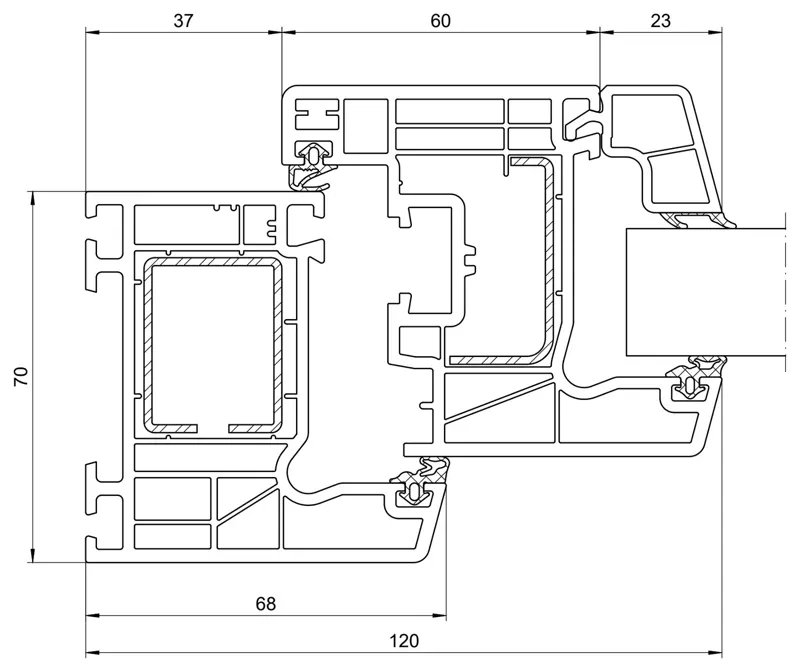
Have an acoustic report for the job? Send it with the schedule.
FAQ
Questions from builders and architects
Are soundproof windows completely soundproof?
No window stops all sound. "Soundproof windows" in practice means windows with a tested sound reduction rating, Rw, high enough to meet the internal noise level set for the room. Schueco tested a CT 70 tilt and turn window at Rw 47 dB with acoustic laminated glass, the top of our range. Your acoustic consultant sets the rating each opening needs.
What does Rw 47 dB mean?
Rw is the weighted sound reduction index of the whole window, measured in a laboratory. Schueco tested a CT 70 tilt and turn window (1230 × 1480 mm) with acoustic laminated glass at Rw 47 dB, test report 21-001425-PR01. A higher Rw means less sound gets through.
What is Ctr and why does my acoustic report ask for Rw + Ctr?
Ctr is a correction for low-frequency noise such as road traffic and heavy vehicles. For the 47 dB CT 70 window, Ctr is −3, so Rw + Ctr is 44 dB. Acoustic consultants often set the requirement as Rw + Ctr for road-facing rooms, so check which figure your report uses.
Which glass do I need for a given dB target?
That depends on the target and the opening type. Schueco's test series on the same CT 70 window ran from Rw 38 dB with a standard unit to Rw 47 dB with an acoustic laminated unit. Send us the acoustic report and we'll match each opening to a glass unit.
Which doors are best for soundproofing a noisy elevation?
Schueco doesn't publish a sound rating for SoftSlide. EasySlide lift and slide doors reach up to Rw 43 dB. On a facing elevation with a high acoustic requirement, a lift and slide door or hinged CT 70 doors are the safer choice.
Can acoustic windows also meet BASIX?
Yes. Thick laminated glass units usually improve the U-value as well. The two targets are checked separately, so give us both the acoustic report and the BASIX or NatHERS glazing schedule.